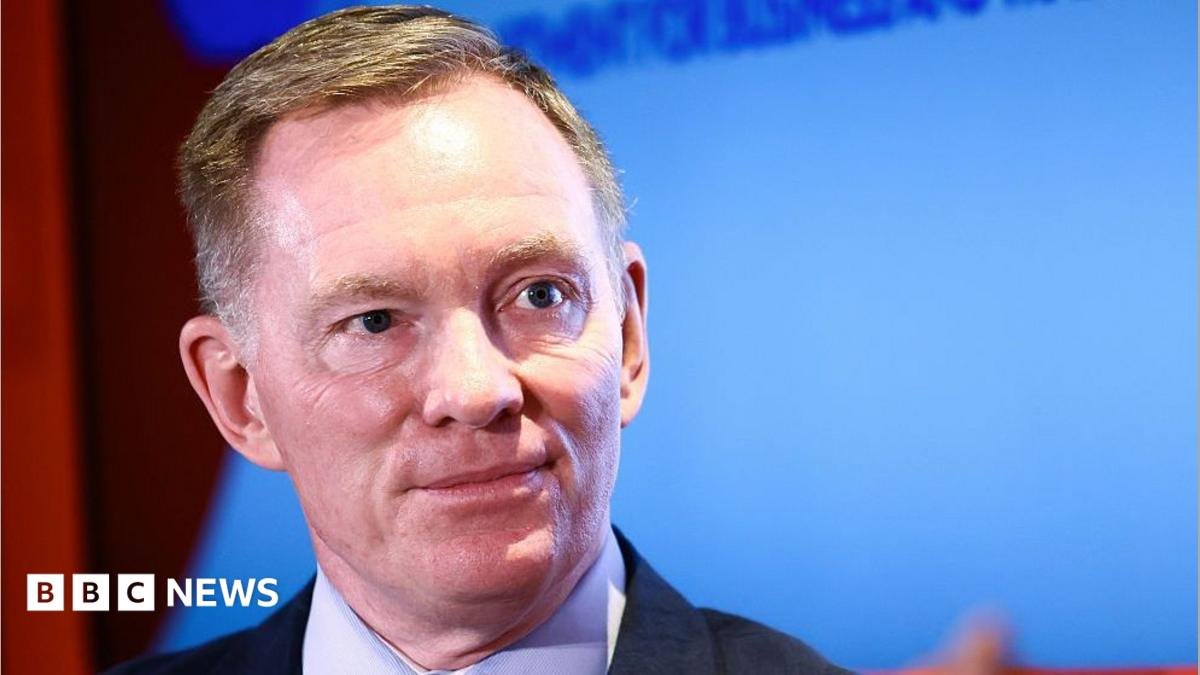
Image caption, Sir Chris Bryant also criticised the performance of Stormont ministers ByJohn Campbell, Economics and business editor and Eimear Flanagan, BBC News NI Published 14 October 2026, 09:45 BST Updated 4 minutes ago The Northern Ireland Secretary has accused the Stormont executive of having little "financial accountability" while also ruling out 'front-loading' extra money the UK government is proposing to give over the next three years.
The executive has not agreed a budget for this year, blaming the UK's devolution funding formula for leaving it short.
Additional funding of £1.5bn would be released in three tranches with £525m available this year.
One idea being suggested is that a larger chunk of the money could be spent in the first year but Sir Chris Bryant told the BBC that is not on offer.
"There is no front-loading to be done," he told BBC Radio Ulster's Good Morning Ulster programme.
"I've made it absolutely clear about 17 times now both to members of the executive and to others that there is no additional money beyond the £525m we have set aside for this year." 'Little financial accountability in executive' Bryant also criticised the performance of Stormont ministers.
"There is very little financial accountability or responsibility across the whole of the executive," the NI Secretary said.
"That's abnormal.
There's no local council anywhere in the UK that doesn't have to bring in a balanced budget.
That's what the executive is going to have to do." He added: "You cannot keep overspending willy-nilly and not expect consequences from that.
It's just irresponsible." Bryant can ultimately impose a budget on the executive by legislating through Westminster.
He suggested the absolute deadline for that is the end of January when executive departments would run out of money under the emergency budget rules on which they are currently operating.
What money is available for Stormont?
Stormont departments are facing a shortfall of up to £1.6bn, according to a spending watchdog, external.
Last month, Bryant made an offer of a financial package worth about £1.5bn over the next three years.
But executive parties said it did not go far enough and have argued that significant gaps remain before they can agree to a deal that would allow them to set a budget.
With no agreed budget, public services have been operating under contingency arrangements allowing departments to spend up to 95% of last year's funding.
Budget row could lead to nurses' strike Image source, Oliver McVeigh/PA Wire Image caption, Health Minister Robbie Butler said the failure to agree a budget was the "primary obstacle" holding up a pay rise for health workers One of the consequences of failing to agree budget is that healthcare staff still have not received this year's pay rise, unlike their counterparts in the rest of the UK.
On Wednesday, the Royal College of Nursing (RCN) opened a ballot for industrial action, external, which may lead to nurses going out on strike over their delayed pay rise.
"It is despicable that, year after year, nursing staff in Northern Ireland are forced to fight for a pay award that colleagues elsewhere in the UK receive as a matter of course," said Prof Rita Devlin, Executive Director of RCN Northern Ireland.
Health Minister Robbie Butler shares the union's frustration, telling the BBC's Nolan Show: "This is like a rinse and repeat which is unhealthy for everybody." He took over the job from Mike Nesbitt less than two months ago and has previously warned that the pay issue could jeopardise recent progress on health reforms.
"We have huge problems that we're trying to fix and sort out and unfortunately industrial action will set us back further," Butler said.
"I impressed this upon my executive colleagues in the very first meeting that I had with them that any good work that has been made and any of the transformation that we have embarked on could be undone if industrial action isn't avoided.
"And the only way we can avoid industrial action is to make the pay award." Asked what was holding up the release of funding, Butler said the failure to agree a Stormont budget "seems to be the primary obstacle".
"Unfortunately with the political instability at the moment it's hard to see that happening," he added.