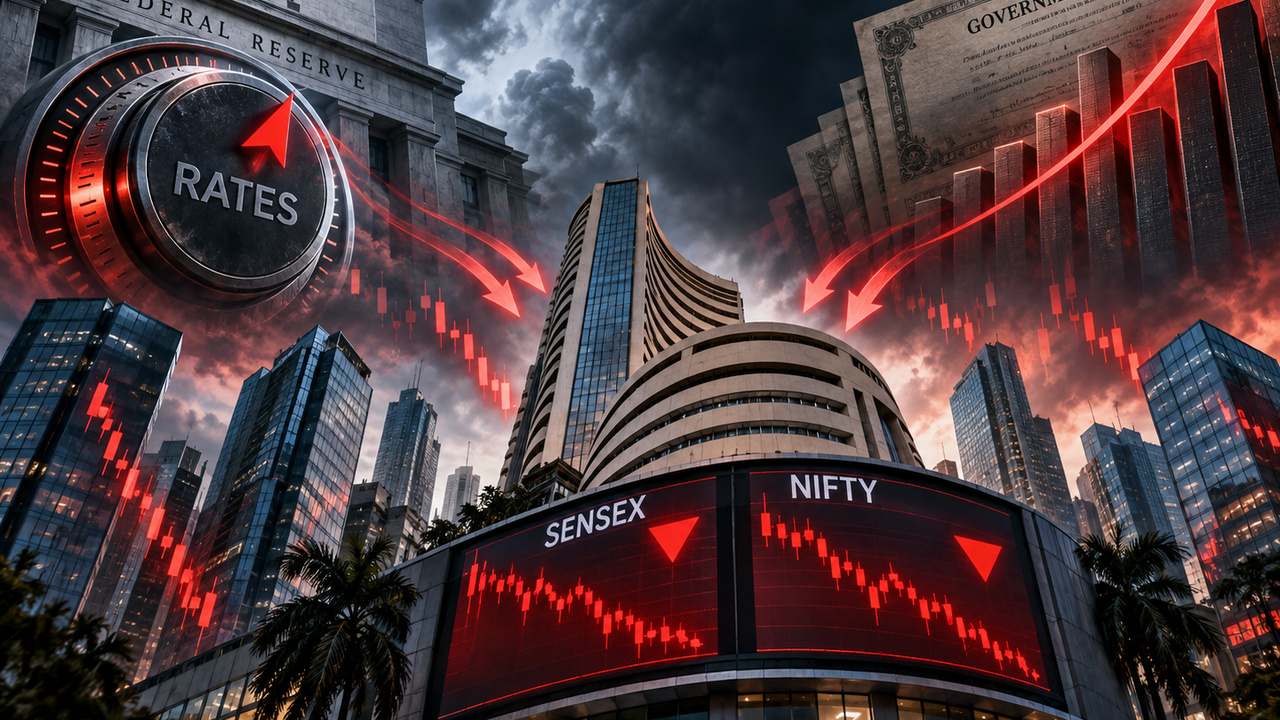
Dalal Street faces a double whammy of Fed rate hike, soaring bond yields.
Are Sensex and Nifty heading for a bigger crash?
ETMarkets.com Synopsis Dalal Street faces pressure from rising US bond yields and expectations of a Federal Reserve rate hike, raising concerns over equity valuations and foreign flows.
However, analysts say the impact may depend on earnings growth, currency movements and global liquidity, with some arguing that higher yields need not necessarily trigger a sharp market correction.
By Debaroti Adhikary, ETMarkets.com Sep 16, 2026, 11:29:00 AM IST Follow us While soaring bond yields continue to spook investors, the US Federal Reserve’s expected rate hike today could add to the worries.
However, analysts advise patience and calm amid the market turbulence.ADVERTISEMENT The benchmark 10-year US Treasury yield crossed the crucial 5% mark this week for the first time since 2023.
The sharp rise in bond yields came as traders increasingly expect the Federal Reserve to keep interest rates higher for longer, after soaring oil prices revived fears of renewed inflationary pressures.The Federal Reserve is all set to announce the outcome of its FOMC meeting today.
The American central bank will likely raise its interest rate, and deliver at least one more hike by the end of March, according to a majority of economists polled by Reuters.
This comes as price pressures have already been running well above the American central bank's 2% annual target.
Rising bond yields typically make the debt market more attractive to investors, which often leads to some downturn in the equity market.
A rate hike by the Federal Reserve also puts pressure on Indian equities.Why analysts advise caution Higher bond yields in developed markets could make emerging-market assets relatively less attractive and potentially lead to capital outflows, said Sudeep Shah, Head of Technical and Derivatives Research at SBI Securities.ADVERTISEMENT Uttam Kumar Srimal, Deputy Head of Fundamental Research at Axis Direct, also echoed the view.
More importantly, a sustained rise in yields could signal tighter-for-longer US monetary policy, increasing pressure on emerging-market currencies, he noted.
Higher interest rates increase the discount rate applied to future cash flows, thereby putting pressure on equity valuations, while a weaker currency and tighter liquidity can further impact investor sentiment and capital flows.
“Although India’s economic growth has remained resilient so far, the evolving global interest-rate and liquidity environment warrants a cautious “wait and watch” approach as we assess how these factors unfold,” he said.ADVERTISEMENT ADVERTISEMENT While stock market traders continue to speculate whether the US Federal Reserve will raise interest rates this month and what impact it may have on equity markets, ‘Dean of Valuation’ Aswath Damodaran called the debate pointless, as fundamentals will determine what the American central bank’s decision will be.ADVERTISEMENT Before Kevin Warsh took charge as the new Fed chief earlier this year, US President Donald Trump had turned up the heat against Warsh's predecessor Jerome Powell for not reducing the rates.
He backed Kevin Warsh, expecting him to cut rates after appointment.
But Warsh’s recent commentary seems to be hinting at rate hikes.
Trump recently called the members of the rate-setting Federal Open Market Committee “clowns”.While pressure mounts on Warsh to maintain a balance, Damodaran believes there is little that the Fed chief or even the Treasury Secretary Scott Bessent can do.
In a long blog post, he noted that the war in Iran, oil prices and worries around a possible recession have all taken turns driving stock prices in 2026, but the talk around interest rates and where they are going has been a constant concern all year.ADVERTISEMENT While investors worry about a possible sharp decline in stock prices due to rising bond yields, Damodaran said it can only happen if the yield increases by more than 3 basis points in one day.
He noted that with the S&P 500 went down almost half a percent on days when the 10-year rate increased by more than 3 basis points and up about half a percent on days when the rate decreased by more than 3 basis points.“The secret to equity resilience in the face of higher oil prices, interest rates and political turmoil has been in equity earnings, which have surged over the course of 2026,” he wrote, adding that history has shown that businesses find ways to deliver higher earnings in the face of higher rates, and markets price in these earnings to deliver solid returns, thus adapting quickly.On the soaring bond yields issue, Yes Securities said this reflects higher equilibrium real rate and synchronised global monetary normalisation, rather than deteriorating economic fundamentals or an imminent fiscal crisis.
In this background, the domestic brokerage feels a 5% Treasury yield need not be restrictive for equities if corporate revenues and earnings continue to grow, as stronger cash flows can offset a higher discount rate. 5% really hurt markets?